Need people to keep coming back to it?
Your training is built and you can see how people use it. Now you want them to finish it, and to go again for a better result. Gamification gives them a reason to.
The idea A virtual reality training experience for our teams


What it is
Game mechanics in something that is not a game.
Gamification takes the parts of games that keep people playing and builds them into something that is not a game: a training course, a learning app, a loyalty scheme, a campaign.
The parts are familiar. Points, levels, leaderboards, rewards, challenges and things to collect. Used well they do one job. They make the behaviour you want visible, and worth repeating.
So we start with the behaviour, not the mechanic. Whether you want customers to return, colleagues to be more productive or learners to remember more, we design the mechanics with you to fit your goals and your people.
What it changes
- Engagement. People interact more often and for longer.
- Motivation. Challenges and rewards push people towards the goals that matter.
- Learning. Interactive, enjoyable practice improves what people remember and can do.
- Productivity. Engaged colleagues are more satisfied with their work.
- Loyalty. Customers return, and feel closer to your brand.
Try it yourself
Watch it work on you.
As you read the four parts below, you earn points, fill the level bar and unlock a badge, as a team member would in a training programme. The standings at the end are an example.
-
Start with the behaviour
Every mechanic begins with one question: what do you want people to do more of? Finish a module, visit every stop, get a procedure right. We agree it with you first, because points for the wrong thing teach the wrong thing.
+100 points Badge: Clear goal
-
Show the progress
People keep going when they can see how far they have come. A level bar, a count of what is left or a set with gaps in it tells them where they stand and what comes next.
+100 points Badge: On the way
-
Answer straight away
A score that arrives a week later changes nothing. Feedback at the moment of the action, right or wrong, turns practice into something people choose to repeat.
+100 points Badge: Quick feedback
-
Reward what matters
A reward only means something when it recognises the behaviour you care about. Then people can see what good looks like, and your organisation sees it improve.
+100 points Badge: Worth earning
Example standings
- 1 You 400
- 2 Amara 310
- 3 Marcus 240
- 4 Elena 190
- 5 Tom 120
Example scores, to show how a leaderboard moves.
The mechanics
What each mechanic is for
You do not need all of them. We choose with you the few that reward the behaviour you want.
| Mechanic | What it does | What we agree with you |
|---|---|---|
| Points | Give every worthwhile action a value, so effort adds up where people can see it. | Reward the action you want, not the easy one to count. |
| Levels | Mark progress through a longer programme, so there is always a next step. | Set the early levels so that nearly everyone passes them. |
| Leaderboards | Show where someone stands against their team, their site or their last result. | Agree with you whether people compare with each other or with themselves. |
| Rewards and badges | Recognise the right behaviour at the moment it happens. | Make each one mean something to the people who earn it. |
| Challenges | Set a clear task with feedback straight away, so practice becomes something people repeat. | Keep the task close to the real one. |
| Collections | Give people a set to complete, so they come back for what is missing. | Show the gaps, so the next find is obvious. |
In the hand
Find it, collect it, answer for it.
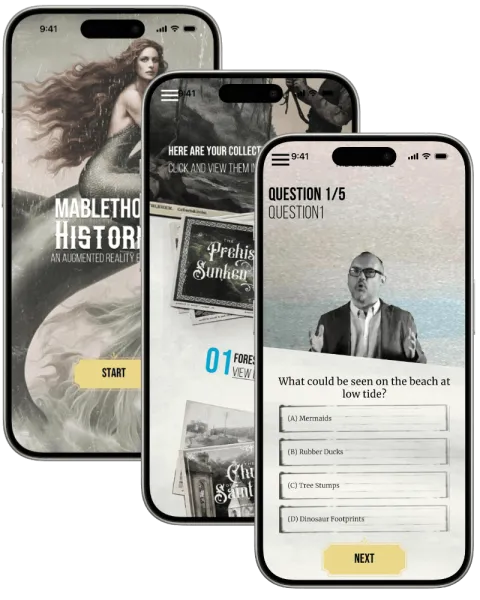
Things to find and sets to complete give people a reason to come back. In RAF100, people collect over 50 of the most iconic RAF aircraft. In our Fife journey, they follow the footsteps of past kings and queens. These screens are from Mablethorpe Histories.
-

Start: a story to step into. -
Discover: each place found is stamped. -
Collect: finds gather into a set to revisit. -

Answer: a short quiz of five questions.
Where it works
Wherever attention is the problem
Five places we would start, each with a different thing to reward.
- Education
- Turn a lesson into something students want to return to. In Race to Zero, made with Fife Council, young students manage an economy, its energy and its social needs as a game.
- Healthcare
- Encourage healthy habits with interactive wellness programmes, where small steps add up and are seen to add up.
- Corporate training
- Make professional development rewarding. Levels and scores give people a reason to finish the module and to practise again, and give managers something to see.
- Retail
- Build loyalty with shopping that has something to find, win or complete, so customers have a reason to come back.
- Non-profit
- Drive participation and giving with challenges people take part in together.
Learning as a game
Run it, and learn from running it.
Race to Zero is an interactive simulation we made with Fife Council. It focuses on economy, energy and social management, and it is there to boost enterprise learning for the area’s young students.
How we work
From the behaviour you want to the first high score
-
Agree what to reward
We form a creative plan with you, starting from the behaviour you want to see more of. Solving that together is one of our favourite parts of a project.
-
Make the content
Our designers, 3D modellers and animators produce the content, and you play it at every step.
-
Build and test
Our developers build the app and test it thoroughly with you before it goes to the platforms you need.
-
Keep it fresh
We keep the app working and up to date, and add new challenges with you when you want to go further.
Where it runs
On iOS, Android and Windows.
Once the app is built and tested with you, we submit it for distribution on the platforms your players use. We choose them with you, starting from who will play and where.
-
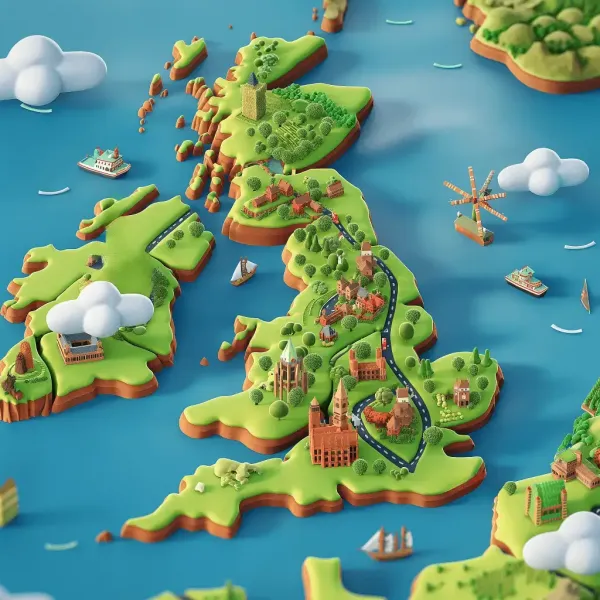 Travel & Tourism
CrossCountry Journeymaker App
We partnered with CrossCountry Trains to create JourneyMaker, a free AR app packed with fun activities for young travellers. From...
Read the story
-
 Travel & Tourism
Mablethorpe Histories
Experience Alderley Edge like never before this innovative mobile app. Using advanced geolocation technology, the app enhances you...
Read the story
-
 Industrial
Jaguar Land Rover
We created an augmented reality app with Jaguar Land Rover to enhance their technician recruitment campaign and create visual inte...
Read the story
Questions
Good to know
-
What can be gamified?
Training, education, health and wellbeing, retail, events, visitor trails and charity campaigns. The projects on this page show some of them.
-
Does it have to be augmented or virtual reality?
No. Game mechanics work in a mobile app, a browser or a headset. We choose the medium with you once we know who will play it and where.
-
Will points and rewards make serious training feel trivial?
They should not. The mechanics reward the behaviour you care about, such as getting a procedure right, so the score means something to your team.
-
Is a leaderboard a good idea for every team?
Not always. Comparing people suits some groups and puts others off, so we agree with you whether to compare people with each other or each person with their own last result.
-
Can we add new challenges after launch?
Yes. We keep the app working and up to date after release, and add new content and features with you when you need them.
Your idea
Talk it through with us
Tell us what you are trying to explain, launch or change. We will work out with you whether this is the right medium for it.
Also in Digital Solutions
Other ways to tell it
-
Artificial Intelligence integration
AI lets an app, headset or web system recognise what a camera sees, understand what people write and find patterns in data. In your training experience, it could recognise the kit a trainee points at.
-
Web systems
Most apps and experiences need a system behind them to change the content, manage who has access and keep the data safe. Edit something once in a web system we build with you and every device shows it.
-
Experience Analytics
Your virtual reality training is live. Now you need to know who finished it, how they scored and which part held people up.
Your turn
What’s your idea?
Tell us the idea you are trying to explain, launch or change, and together we will find the right way to tell it.