Skip to content

Need to show people something that is not built yet?

A product still in design, a mechanism hidden inside a machine or a character that only exists as a sketch is hard to show with a camera. We model and animate it with you, so people can see what it looks like and how it works.

The idea Let customers see our new product before it exists

A rendered charge point with a rounded champagne metal case and a dark Andersen label, lit against a grey studio backdrop
Champagne metal.
The same charge point with a teak wood front panel in vertical slats and a steel label
Teak.

One model, two finishes

The Andersen charge point, modelled once and shown in champagne metal and in teak. Because it is a model and not a photograph, a finish can change without a new photo shoot.

Four stages

From wireframe to final frame

Every model goes through the same four stages. Move through them to see what changes, and where you can step in.

  1. Wireframe

    We start with the bare structure: points and edges that fix the shape and the proportions. It is quick to change, so this is where you check the form with us.

  2. Solid model

    The edges become surfaces. You can turn the object round and judge its mass, scale and detail before colour gets in the way.

  3. Textured

    Materials go on: metal, wood, glass, fabric or skin. We use physically based materials, which react to light the way the real ones do.

  4. Lit and rendered

    We set the light, from natural sunlight to a studio rig, and render it as a still, a film or a real-time scene for the web and headsets.

When to use it

Use it when a photograph cannot show it.

A 3D model is an accurate digital version of a product, building, character or place, with its materials and lighting. Animation makes it move, so it can show how it works.

  • It is not made yet

    A product, a building or a piece of equipment still in design. People see it from every angle, in the finishes and options you offer, before it is manufactured.

  • The important part is hidden

    The inside of a machine, or a process too small or too fast to film. Animation shows what a camera cannot, in a few seconds.

  • It needs someone to follow

    Stories for children, training and campaigns often need a character. We design and animate one with you, realistic or stylised, to suit your audience.

What we make

Things that stand still, and things that move

Still

3D modelling

  • Characters and creatures

    From stylised characters to lifelike creatures, built with attention to anatomy, texture and personality.

  • Architectural visualisation

    Exteriors, interiors and landscapes for presentations, property marketing and virtual walkthroughs.

  • Product prototyping

    Accurate models of a product before it is made, so its design and function can be judged early.

  • Environments and sets

    Immersive places for games, films and simulations, with the textures and lighting that make them believable.
In motion

Animation

  • Motion graphics

    The precision of a 3D model with the pull of animation, for branding, advertising and social media.

  • Character animation

    Expressive, lifelike movement for games and for augmented and virtual reality, so every motion fits the character and its story.

  • Simulation and physics

    Particles, fluids and soft bodies that follow real-world physics, for effects that look natural.

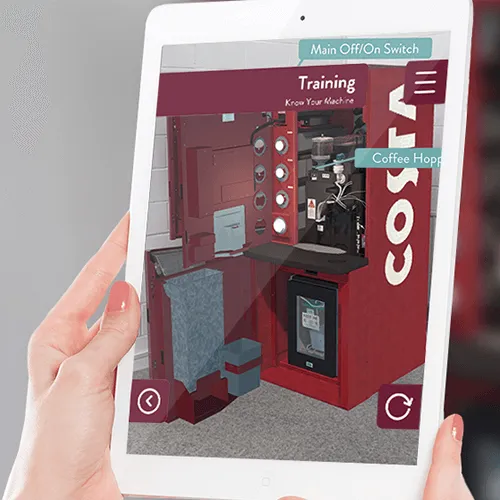
Costa Express: a 3D model of the machine, used in an augmented reality app that trains and troubleshoots.

A model at work

Realistic when it helps, stylised when it suits

Realism is not always the goal. Alongside physically accurate materials and light, much of what we make is stylised, for children’s entertainment and for training, where a clear shape is worth more than a perfect reflection.

We decide how far to go with you, from the audience and the screen it will be seen on. The projects below show the range.

How we work

From reference drawings to a model that moves

  1. Agree what it is for

    You share drawings, design files or photographs, and we agree with you where the model will appear, because a film and a phone app need different levels of detail.

  2. Model and light it with you

    Our 3D artists build the shape, materials and lighting, and you check it from every angle while it is still easy to change.

  3. Animate and deliver it

    We rig and animate it, go through the movement with you frame by frame, then render it as film or stills or prepare it for real time on the web, in apps and in headsets.

Where it ends up

One model, three places to show it

We agree where the model will appear before we build it, because that sets how much detail it carries.

Where a finished model is shown
Where What we deliver What we agree first
Film and stills High-resolution renders, as single images or animated sequences. How much detail the finished frame needs to carry.
Websites and apps Real-time 3D that people can turn, open and change on their own screens. How light the model must be to load quickly on a phone.
Headsets Models and animation prepared for augmented and virtual reality. How close people will get to it, and so how much detail it needs.

Tools we use

  • Blender
  • Autodesk Maya
  • 3ds Max
  • Substance Painter
  • V-Ray
  • Arnold

Questions

Good to know

  • What can you model?

    Products, buildings and interiors, characters and creatures, and whole environments for games, films and simulations. The projects on this page show some of them.

  • Can one model be used in more than one place?

    Yes, if we plan for it with you at the start. A model for film can carry far more detail than one that has to load quickly on a phone, so we agree where it will appear before we build it.

  • Is all your 3D work realistic?

    No. Alongside realistic materials and lighting, much of our work is stylised, for children’s entertainment and for training.

  • What do we need to bring?

    Whatever you have: drawings, design files, photographs or just a description. We will work out with you what is missing.

  • Which software do you use?

    Blender, Autodesk Maya and 3ds Max for modelling and animation, Substance Painter for textures, and V-Ray and Arnold for rendering. Models for apps and headsets are prepared for real-time engines.

Your idea

Talk it through with us

Tell us what you are trying to explain, launch or change. We will work out with you whether this is the right medium for it.

Your turn

What’s your idea?

Tell us the idea you are trying to explain, launch or change, and together we will find the right way to tell it.