A practical guide to capacity and revenue forecasting for standalone LBVR experiences using slot-time throughput, sensible pricing, and realistic fill-rate assumptions.
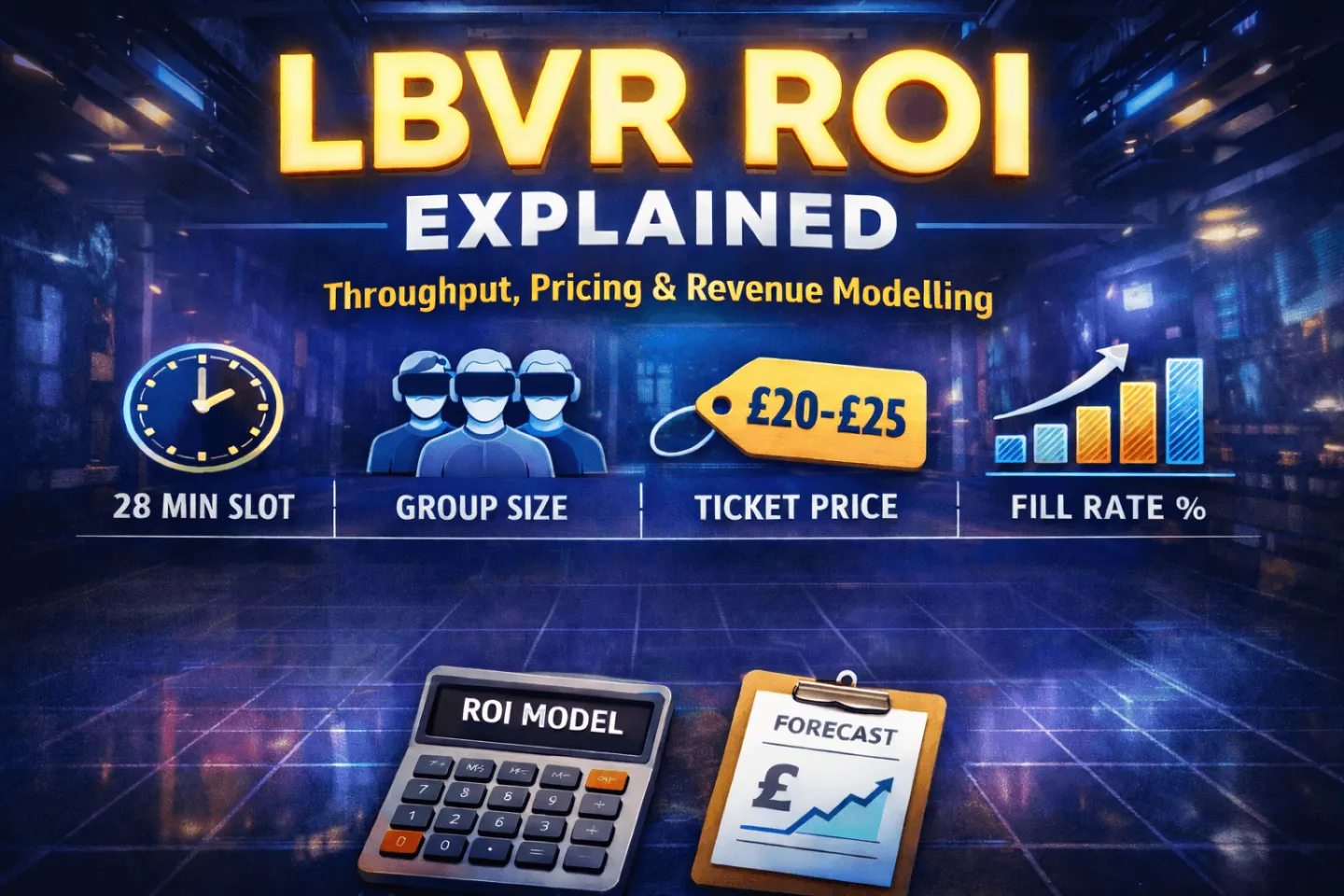
If you’re selling LBVR as a standalone paid experience, your revenue, when you have the footfall, is mainly driven by two things:
- how many people you can run per hour
- how consistently you can start sessions on time
The easiest way to forecast sensibly is to base your numbers on the ticketed slot (not just the time in headset). In this article we run through the calculations to consider. At the bottom you will also find our handy calculator to help with this.
The quick calculator
Use these two timings:
- Headset cycle (best case): experience time + turnaround
- Ticketed slot (forecast): experience time + turnaround + onboarding/briefing buffer
Then:
- Sessions per hour = 60 / slot time (minutes)
- Guests per hour = sessions per hour × guests per session
- Revenue per hour = guests per hour × average ticket price
- Average hourly revenue = revenue per hour × average fill rate

Revenue per hour at £20, £23, and £25
Using the ticketed slot throughput (42.9 guests/hour):
- £20 average ticket: 42.9 × 20 = about £860/hour
- £23 average ticket: 42.9 × 23 = about £990/hour
- £25 average ticket: 42.9 × 25 = about £1,070/hour
A useful point for decision-makers: reliability and slot-fill usually matter more over a month than squeezing a couple of pounds onto the ticket.
Pricing in London (Example): £20 vs £25
For a 15 minute standalone LBVR experience, both prices can be right, depending on positioning.
£20 tends to work well when:
- the overall booking feels short end-to-end
- you want to stay accessible for walk-ins and families
- you’re aiming for volume and repeat visits
£25 tends to work better when:
- it feels premium (production value, strong storytelling, polished hosting)
- peak-time demand is strong
- your booked slot is meaningfully longer than the headset time
If you want a simple approach that stays flexible:
- from £20 off-peak
- up to £25 peak
If you prefer one flat modelling number, £23 is a sensible middle ground.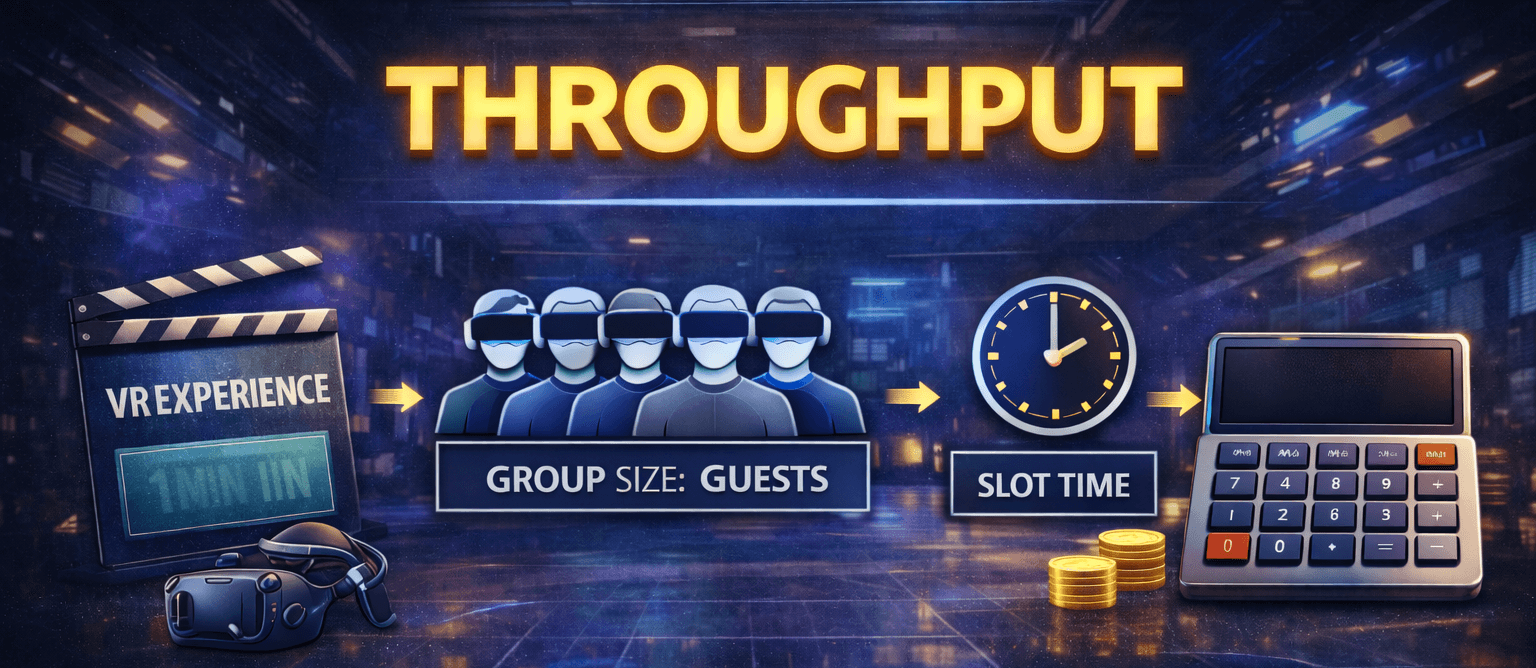
Add the reality factor: average fill rate
Most venues are not full all day. Apply a fill rate to keep forecasts realistic.
If you model at £23 (about £990/hour at 100% fill):
- 40% fill: about £400/hour
- 60% fill: about £590/hour
- 80% fill: about £790/hour
This is the range that tends to hold up in real operations.
What usually steals time (and breaks the timetable)
These are the common causes of how “28 minutes becomes 35”:
- fitting headsets without a set routine
- briefings that drift longer each session
- late arrivals delaying the whole group
- resets depending on one person doing everything
- charging, spares, and cleaning kit not set up for speed

How to increase capacity without making it feel rushed
The goal is consistency, not stress.
- Pre-brief while guests wait (screen or signage), keep the live brief short
- Standardise fitting with a simple checklist and a clear “ready” signal
- Split staff roles at peak (briefing, fitting, reset)
- Protect start times with a clear late policy and a small buffer every few slots
- Make reset a station (spares and cleaning laid out, not stored away)
Use our handy calculator to forecast your specific LBVR scenario
The biggest difference between a good forecast and an optimistic one is using the ticketed slot time, not just the headset time. Use the calculator below to model your expected slot length, group size, ticket price, and average fill rate.
LBVR Revenue Calculator
Duration of the VR experience
Cleaning & reset between groups
Safety briefing & equipment fitting
Max headsets running simultaneously
Per guest, per session
Average Revenue / Hour
at % fill rate
Slot Time
Sessions / hr
Guests / hr
Revenue / hr (100%)
Read to build your LBVR experience?
Need help pressure-testing your plan? We can:
- sense-check your slot length, staffing, and fill-rate assumptions
- design an operating flow that starts on time
- develop the LBVR experience and deliver the full setup (hardware, install, and launch support)
Get in contact today and we can help you get there.
Frequently Asked Questions
Want to learn more? Get in touch

About the author
Kieran Sawyer
Your idea
Talk it through with us
Tell us what you are working on, from an early idea to a brief that is ready to go, and we will think it through with you.