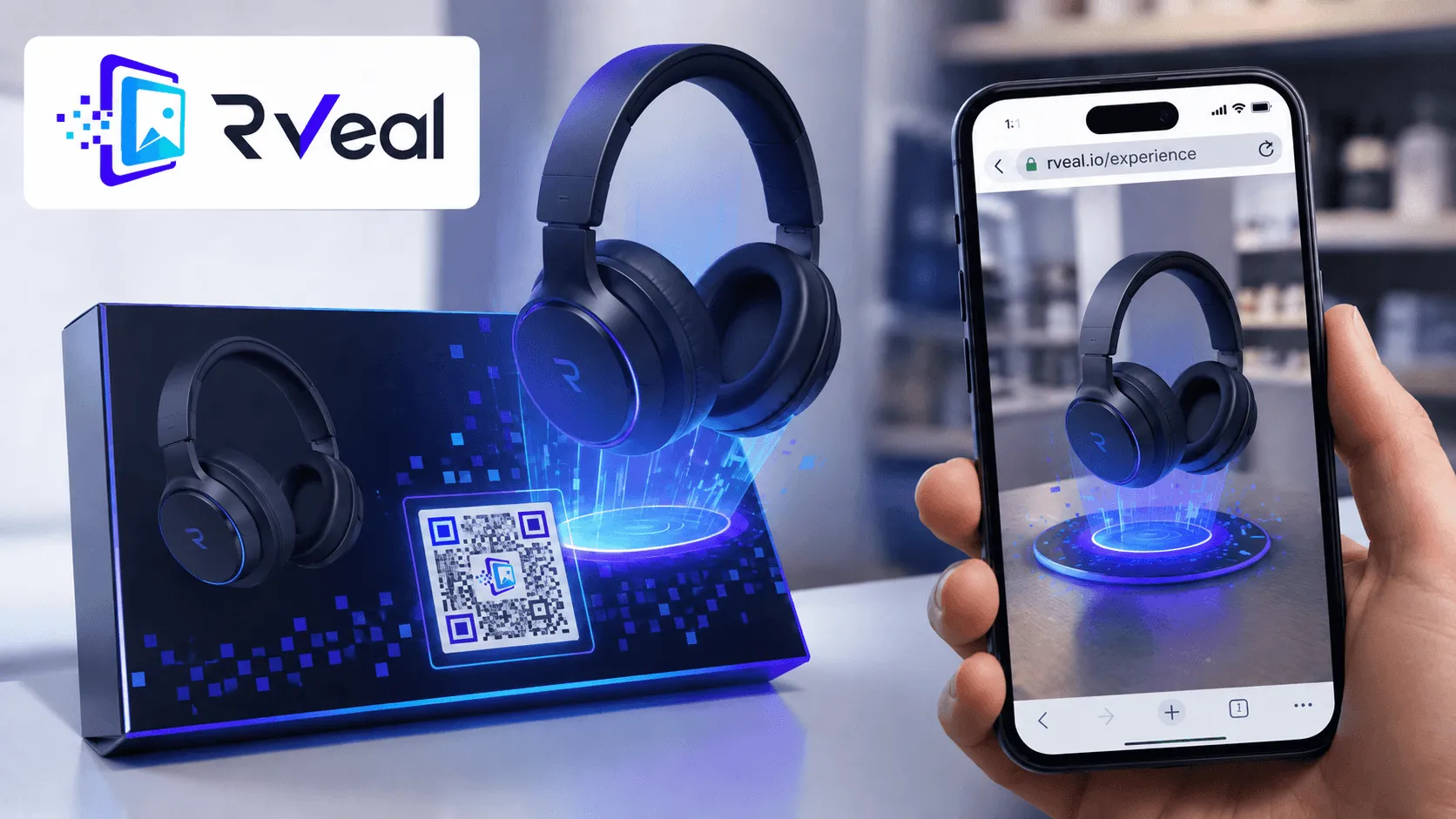
Everyone loves augmented reality, but the biggest hurdle is getting users to download an app to experience it. That single step (find the store, download, grant permissions, open) is where the audience you worked so hard to reach drifts away. The experience can be brilliant, and most of the people you showed it to will never get there.
We built RVeal to remove that step. It's our new platform for web-based AR: experiences your audience opens straight from a link, with nothing to install. It runs directly in their mobile web browser of choice - no extra installs, frictionless immersive experiences.
The step that loses your audience
The app download looks small on a slide and feels enormous in the wild. Most people are far more reluctant to add an app than marketers assume. comScore found that in a typical month the majority of US smartphone owners download no new apps at all1. That figure is a few years old now, but the behaviour it describes hasn't shifted.
So when an AR campaign's first instruction is 'download our app', you're asking the audience to do the one thing most of them rarely do, before they've seen anything worth the trouble. Every step in that chain sheds people. By the time the camera finally opens, the crowd that gathered around the idea has thinned to a handful.
This is the gap that has held AR back as a marketing tool. Not the quality of the experiences, which has been good for years, but the cost of entry to see them.
What RVeal does differently
RVeal closes that gap by putting the whole experience in the browser people already have. Your audience scans a QR code or taps a link, and augmented reality starts in Safari or Chrome on their phone, on the spot. No app, no store, no install. A tap is the only step.
Underneath, the phone works out where it is in the room, much as you'd glance around an unfamiliar space before setting something down on a table. That lets RVeal anchor a 3D scene to a real surface (a countertop, a desk, a display stand) without any special markers. Alternatively, it can lock onto a printed image you choose, so pointing a phone at your packaging or a poster opens the experience right there on the object. The technology behind the first method has a name, SLAM, but the only thing that matters to your audience is that it works on the phone in their pocket.
We built RVeal at Harmony, where we've been doing digital and immersive work since 1995 for brands including Unilever, Sky and BP. We say that plainly because it should matter when you're weighing the tool up: this isn't an experiment from an unknown startup, it's built on years of us doing the hard parts of AR for large clients. We've folded that experience into the platform, so the engineering is handled and your job is the idea and the content, not the code behind it.
The point worth holding onto is simple. Removing the install isn't a minor convenience; it's the difference between an experience a few enthusiasts reach and one your whole audience can.
Build it, brand it, own it
We didn't build RVeal as a locked template you drop a logo into. You build the entire experience in the browser. Upload a 3D model, place it on the surface, adjust its materials and lighting, then wire up taps, hotspots and call-to-action links that send people to your own site or checkout. What you assemble is exactly what your audience sees.
Because the experience lives on a web page rather than inside an app, you control everything around it too. Product details, a 'buy now' button and your own branding sit alongside the AR viewport.
There's no app-store queue between you and going live, either. When you publish, it's live. If you need to swap a model for a sale or fix a line of copy, you change it and the update is there the next time someone opens the link. For a marketing team working to a campaign calendar, that agility is worth as much as the AR itself.
Why it pays off
AR earns its keep when people actually reach it. The commercial case is already well established: Shopify reported that products with 3D or AR content converted at roughly 94% higher than the same products without it2. Augmented shopping has moved from novelty to habit. Deloitte Digital and Snap have tracked AR's shift into mainstream retail behaviour, with well over 100 million people now shopping with it3. Those numbers are real, but every one of them assumes the audience got to the experience in the first place. That assumption is precisely what the install step breaks, and what opening from a link restores.
The places this matters are the ones where the audience is already holding something physical or standing in front of something real. A shopper can spin and configure a product from its packaging before buying. A visitor at an event or exhibition stand can join in with a tap, rather than queuing to install software on borrowed Wi-Fi. An estate agent can place a model of a development in a client's actual room. A trainer can make a complex object tangible on any phone in the room. Picture a drinks brand putting a QR code on the back of a bottle: a shopper scans it on the shelf, the product comes alive on the label with a tap to buy, and not one of them had to leave the aisle or install anything. In each case the link, not the app, is what makes the experience reachable at the moment of interest.
What this means for you
If you've ever shelved an AR idea because the app build was the dealbreaker, whether too slow, too costly, or simply one barrier too many for the audience, the calculation has changed. The experience no longer has to justify a download before anyone sees it.
The sensible way in is small. Pick one product, one poster or one campaign page, build a single experience, and put a QR code on something your audience already touches. RVeal is free to start, with no card required, so the first test costs you nothing but the time to make it. Watch the dwell-time figures, then decide what's worth doing next.
References
- comScore (via TechCrunch), 'Majority of U.S. consumers still download zero apps per month, says comScore', 25 August 2017. techcrunch.com — most smartphone owners download no new apps in a typical month.
- Shopify, 'Interactions with products having 3D/AR content showed a 94% higher conversion rate than for products without AR/3D' (Shopify merchant data, 2020); see also 'The ROI on AR'. shopify.com — AR conversion-uplift figure.
- Deloitte Digital & Snap Inc., 'Augmented shopping: the quiet revolution', Deloitte Insights, 2021–2022. deloitte.com — AR shopping has reached mainstream scale (100M+ consumers).
Reveal your first experience
Create a free account and publish browser-based AR your audience opens straight from a link. No card required.
Start free-
Alex Hollyman is Lead Web Developer at Harmony Studios, with 20 years of experience as a web and WebXR developer. He helps turn creative ideas into robust, engaging digital experiences for clients across a wide range of projects.
Profile -
Date
Jul 1, 2026
-
Reading time
7 min read

Max 500 characters (0/500)