A practical guide to the factors that shape LBVR development costs, from hardware and content creation to arena design, deployment and long-term support.
Location-Based Virtual Reality can be a powerful commercial opportunity, but one of the first questions every client asks is also one of the hardest to answer with a single number.
How much does an LBVR experience cost to build?
The honest answer is that it depends on what you are creating, where it will be deployed, how many people it needs to support, and how polished the final experience needs to be. A compact branded activation, a touring installation, and a permanent free-roam attraction may all use LBVR technology, but their budgets, operational demands, and development timelines can be very different.
At Harmony, we treat cost planning as part of the design process. The goal is not simply to reduce spend. It is to invest in the right areas so the experience is reliable, commercially viable, and strong enough to meet audience expectations.
How much does an LBVR experience cost to build?
There is no single fixed cost for location-based virtual reality development. LBVR budgets vary depending on the size and complexity of the experience, the number of simultaneous players, the hardware setup, the amount of bespoke content required, and the level of testing, deployment and ongoing support needed.
Why there is no single LBVR cost figure
LBVR is not an off-the-shelf product. It is a combination of software, spatial design, hardware integration, content creation, testing, and operational planning.
Two experiences can look similar from the outside but have very different cost structures behind the scenes. One may be built around simple, repeatable mechanics for a short activation. Another may include multiplayer networking, bespoke environments, physical set integration, custom peripherals, or complex visitor flow requirements.
That is why meaningful cost planning should start with the intended experience and the commercial model behind it, not just with a headset count.
The main factors that shape LBVR development cost
1. Experience scope
The biggest cost driver is usually the scope of the experience itself.
Questions that affect budget include:
- Is it single-user or multi-user?
- Is it a short branded experience or a full attraction?
- Does it rely on simple interactions or more advanced gameplay systems?
- Does it need original characters, environments, animation, or narrative content?
- Will the experience need to evolve after launch?
A highly polished multiplayer attraction with bespoke assets and robust session logic will naturally require more development than a lightweight installation with limited interaction.
2. Physical space and arena design
LBVR starts with the real-world environment.
A small footprint can be designed efficiently, but larger or more complex arenas usually require additional planning, calibration, safety consideration, and operational logic. Arena size also affects how players move, how staff support the session, and how much content is needed to make the experience feel rich rather than repetitive.
The more ambitious the spatial design, the more closely the physical and digital layers need to be coordinated.
3. Hardware and technical infrastructure
Hardware costs are only one part of the picture, but they matter.
Depending on the project, you may need wireless headsets, controllers, charging systems, local network infrastructure, spare devices, storage solutions, and optional immersion layers such as haptics or tracked props.
The right hardware stack is not necessarily the most expensive one. It is the one that best matches your operating model, expected throughput, and support requirements.
4. Content creation
This includes far more than simply making a 3D world look good.
Content costs can include:
- concept development
- environment design
- 3D modelling and animation
- user interface design
- sound design
- narrative design
- interaction design
- optimisation for real-time performance
For premium attractions, content quality has a direct impact on perceived value, pricing power, and word of mouth.
5. Multiplayer and systems development
If your LBVR experience supports multiple participants in a shared virtual world, technical complexity increases.
Real-time synchronisation, arena mapping, player safety logic, session control, reset flow, and operator tooling all add development overhead. These systems are essential to making the attraction feel seamless for guests and manageable for staff.
6. Testing, iteration, and deployment
LBVR has to work in the real world, not just in a demo build.
Testing covers comfort, reliability, usability, safety, latency, throughput, and repeatability. It is common for practical issues to emerge only when the experience is run under venue-like conditions with real users, real timings, and real reset cycles.
That is why testing and optimisation should be treated as part of the core build, not as an optional extra.
LBVR cost drivers at a glance
| Cost factor | What affects it | Why it changes budget |
|---|---|---|
| Experience scope | Single-user or multi-user, session length, gameplay depth, narrative complexity | Larger, more ambitious experiences need more design, development and testing |
| Content creation | 3D environments, animation, sound, UI, interaction design | More bespoke content increases creative and production time |
| Hardware | Headsets, controllers, charging, networking, storage, peripherals | Different hardware stacks have different setup, support and replacement costs |
| Arena design | Size of footprint, player movement, safety requirements, physical set integration | More complex spaces require more planning, calibration and operational thinking |
| Multiplayer systems | Shared worlds, synchronisation, session management, operator controls | Multi-user experiences usually require more technical development |
| Testing and optimisation | Comfort testing, reliability, usability, venue-style trials | Real-world iteration is essential for a smooth guest experience |
| Deployment | Installation, setup, staff workflows, venue integration | Launching in a live environment adds practical delivery requirements |
| Ongoing support | Maintenance, content updates, hardware replacement, technical support | Long-term operation creates costs beyond the initial build |
Build cost versus operating cost
A common mistake is to think only about the initial development budget.
A successful LBVR attraction also needs an operational model. That includes staffing, cleaning and reset procedures, support, content updates, device replacement planning, and the practical realities of running sessions on time.
A lower-cost build can become expensive very quickly if it creates operational friction. Equally, investing more upfront in better flow, stronger tools, and more robust systems can improve long-term efficiency.
How to approach LBVR budgeting sensibly
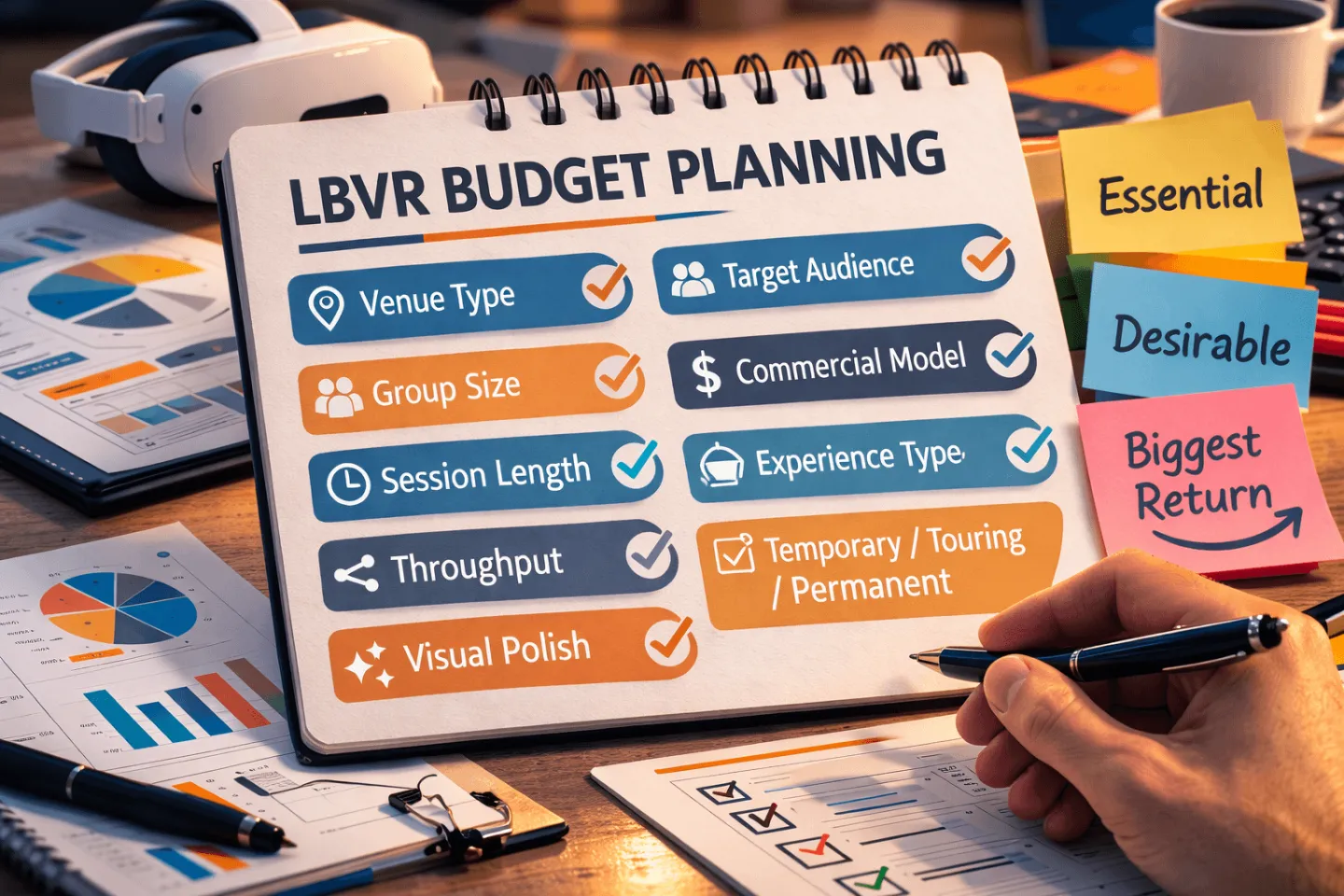
The best way to budget for LBVR is to break the project into decisions rather than chase a headline figure.
Start by defining:
- your venue type
- your target audience
- your desired group size
- your session length
- your throughput expectations
- your commercial model
- your required level of visual polish
- whether the experience is temporary, touring, or permanent
From there, you can identify what is essential, what is desirable, and where the biggest commercial return is likely to come from.
The real question is not just what it costs
A better question is this:
What does it need to cost in order to achieve the experience and commercial outcome you want?
That shift matters. An attraction designed to generate repeat visits, premium ticket pricing, and strong social sharing should be budgeted differently from a one-off event installation. The right budget is the one aligned to the purpose of the experience.
Planning LBVR with commercial reality in mind
At Harmony, we help clients shape LBVR concepts from the outset, balancing creative ambition with operational and commercial realities. That includes early-stage planning around hardware, content scope, arena design, deployment, and long-term support.
If you are exploring an LBVR project and want to understand the likely cost drivers before committing to development, we can help you scope the opportunity properly.
Frequently Asked Questions
Want to learn more? Get in touch

About the author
Kieran Sawyer
Your idea
Talk it through with us
Tell us what you are working on, from an early idea to a brief that is ready to go, and we will think it through with you.