Skip to content

Showcase

Understanding Alzheimer’s Disease

An interactive 3D experience exploring how Alzheimer’s disease changes the brain and disrupts communication between neurons.

Launch showcase (opens in a new tab)

See it running

Hosted at www.harmony.co.uk — opens in a new tab.

An interactive educational experience created to explain how Alzheimer’s disease affects the brain and how those physical changes can influence memory and communication.

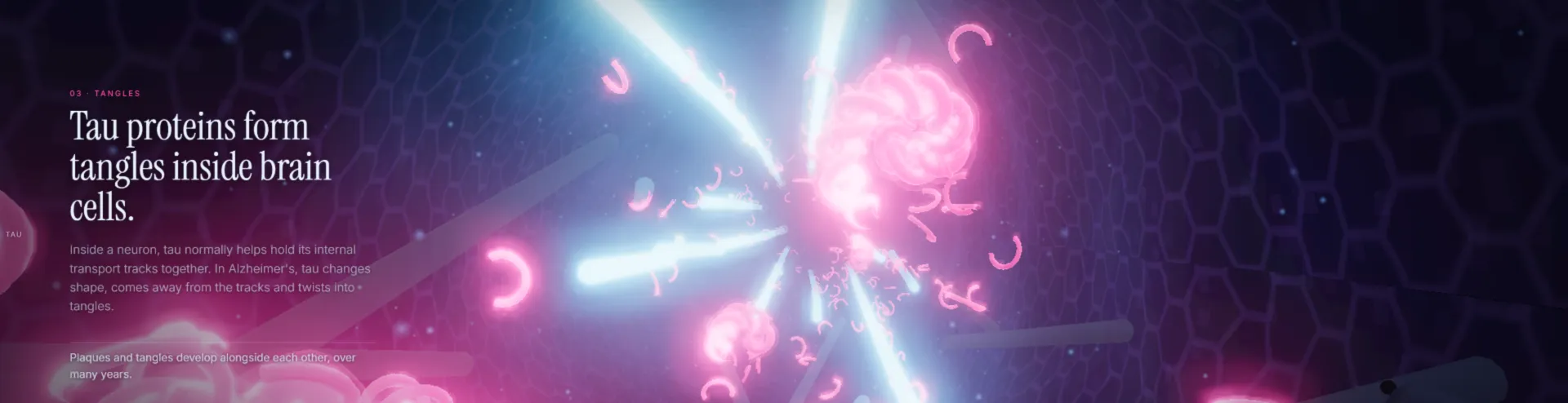
The experience takes users inside the brain, moving from a healthy neuron through the development of amyloid plaques and tau tangles, before showing how these changes disrupt communication between brain cells.

Complex biological processes are broken down into a clear visual journey, helping users understand what is happening at a cellular level and how this can translate into the symptoms experienced by patients.

The experience combines 3D visualisation, animation and interaction to make a difficult subject easier to explore and understand.

Frequently Asked Questions

Want to learn more? Get in touch

An interactive 3D medical explainer uses animation, visualisation and user interaction to make complex healthcare topics easier to understand. It can show anatomy, disease progression, mechanisms of action, treatment pathways or other scientific processes in a more visual way than static diagrams alone.
Interactive 3D can help users understand processes that are difficult to explain with text or flat imagery. It allows people to explore structures, follow changes over time and see how events at a cellular level can affect the wider body.
Yes. The same approach can be used for a wide range of healthcare subjects, including disease awareness, mechanisms of disease, mechanisms of action, diagnosis, treatment pathways, medical devices and patient education.
Yes. The scientific depth, terminology, visual style and level of interaction can all be adapted to suit the audience. An HCP-focused experience may include more detailed scientific information, while patient-facing content can use simpler language and a more guided approach.
Yes. Interactive 3D is useful anywhere a subject is difficult to explain using words or static images alone. It can be used for engineering, finance, manufacturing, education, training, technology, product demonstrations and other complex subjects where showing how something works is more effective than simply describing it.
Experiences can be built for websites, touchscreen displays, tablets, laptops, exhibitions, congresses and events. Browser-based experiences can also be accessed through a QR code, allowing users to explore the content without installing an app.
Share

Max 500 characters (0/500)

Harmony Studios

Hey there! Want to chat about your next project? Book a quick meeting with our team.

Book a meeting