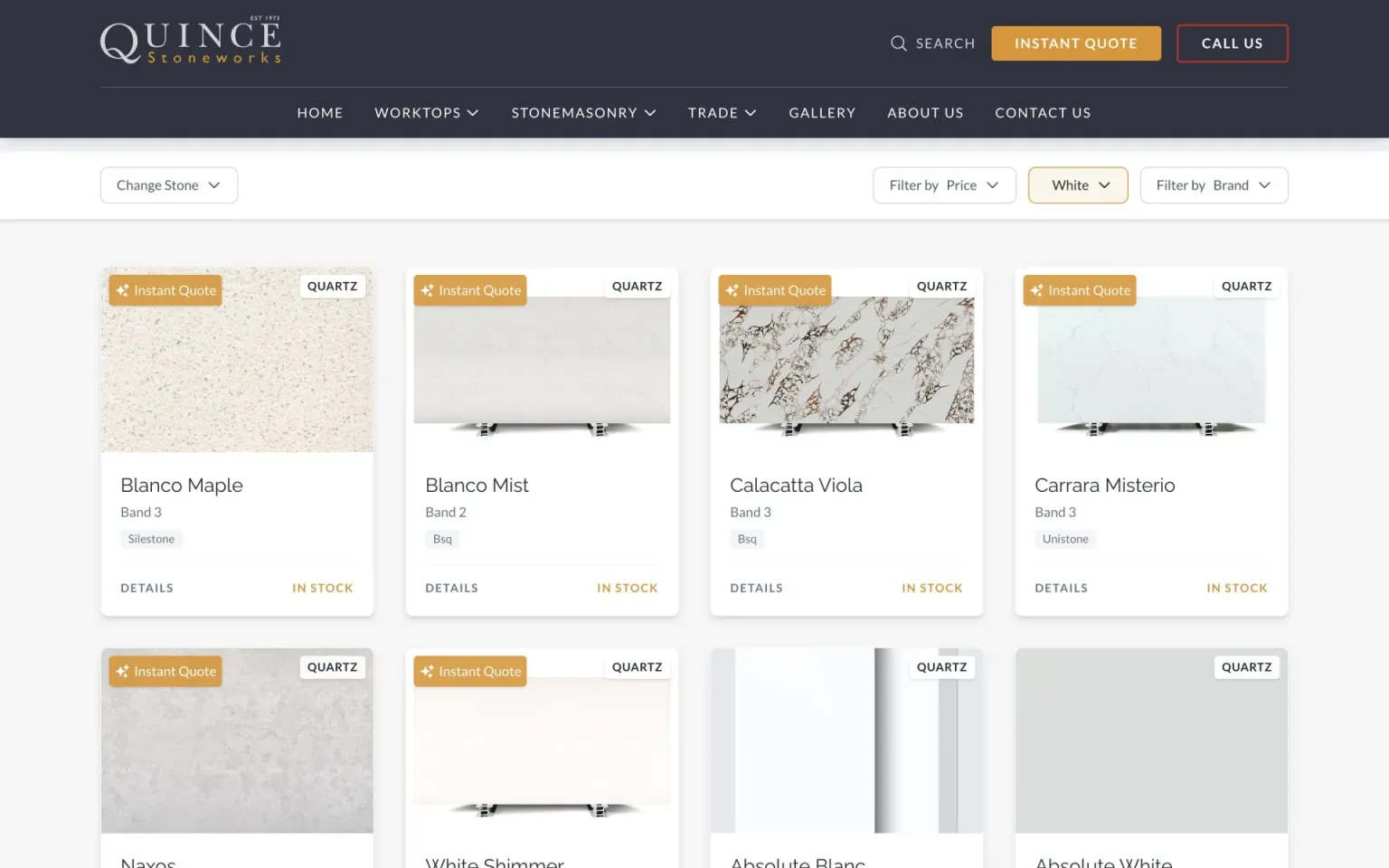
Most businesses that sell products have a list of them somewhere. Quince Stoneworks had one: their suppliers, and the stone each supplier offers. A list is not a catalogue, though. Someone choosing a kitchen worktop wants to see the stone, filter by colour and compare brands, and the list only had names.
When we rebuilt the Quince Stoneworks website with them in 2026, the full range was part of the brief: every material from every supplier, with a photograph, a colour and a type. This is how we used AI to get there, and where people did the checking.
Three weeks of copying and pasting
For each stone, somebody has to find the supplier’s product page, save the photograph, check the stone is still being made and write down its colour and type. Allow five minutes a stone. The finished catalogue holds 1,366 of them from 19 brands, which comes to more than 110 hours: about three working weeks for one person doing nothing else.
Nobody at a busy stonemason has three spare weeks. The work is dull and repetitive, and a tired person makes mistakes in it. It also comes with clear instructions and answers you can look up, which makes it a good fit for AI.
What we asked AI to do
The request was short. For every material on the list: find the supplier’s product image, check the product is in their current range, then work out its colour and stone type.
AI worked through the list one supplier at a time and wrote the results into a single file. Each row holds the stone’s name, brand, type, colour, description and image, along with the address of the supplier’s page it came from.
The film follows the catalogue from the client’s list to the live site in 30 seconds. The list, the AI session and the file are re-created for the film. The import and the website are screen recordings.
Working out a colour nobody had written down
Suppliers do not describe colour in the same way. Some give a plain word. Some use their own range names, so white is Bianco and black is Nero. Some write a whole phrase, such as “pale cream with light veining”. A few give nothing at all.
A customer wants to tick White and see white stones. So where the colour was missing, AI worked it out from what was there: the photograph and the supplier’s description. Take a description like “fine-grained white quartz compound stone with darker grey veins”. It names two colours. The photograph shows which one a customer would use: a white slab with thin grey veins, so the stone is filed under White.
This is also the slowest part to do by hand, because every stone needs somebody to look at it and decide.
Where people checked the work
AI makes mistakes, and on a live website a wrong photograph or a discontinued stone becomes the client’s problem. So we built the checks into the process with the Quince Stoneworks team.
Nothing goes from AI straight to the website. The file goes through an importer we built into the admin area, which validates it and shows a summary before it changes anything: 1,366 entries, 19 brands and 3 stone types, with a count for each brand. A person reads the summary and starts the import. Somebody who knows the business can tell quickly whether 57 Silestone products sounds right.
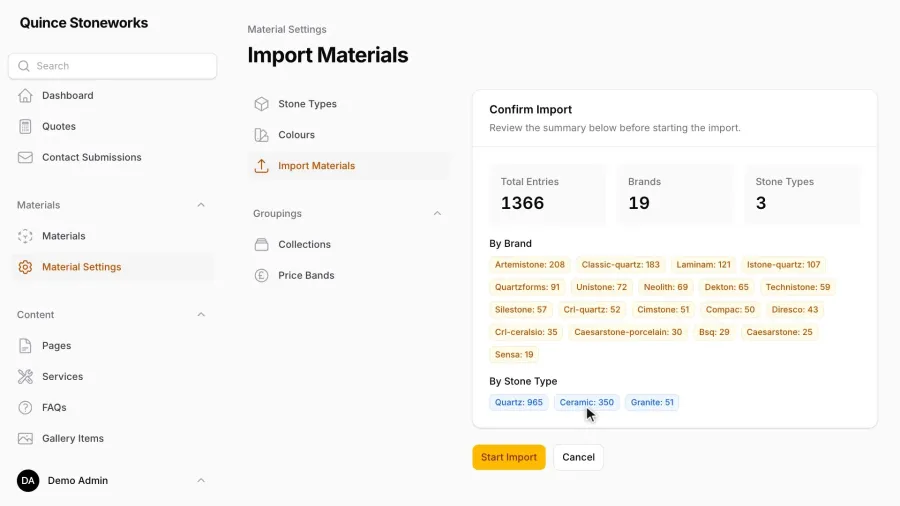
The importer does not guess. If it cannot place a row, because it does not recognise the stone type for instance, it skips the row and reports it for a person to look at. In the run shown in the film it created all 1,366 materials and skipped none.
Every stone keeps the link to the supplier’s page it came from, so anyone in the team can open the source from the admin area and compare it with what we hold.
The team can also correct what they find. They can edit any stone, and they can merge two colours into one where suppliers’ names overlap, so Nero and Deep black both sit under Black. Running the import again updates a stone that has the same name and brand, so a correction never leaves a second copy behind.
Where we kept AI out
No AI runs on the live site. The catalogue customers browse is ordinary data in a database, filtered by colour, brand, stone type and price band. AI has no part in the instant quote either. A quote has to be exact and the team has to be able to explain it, so it follows rules the team controls.
What it saved
The hours are the obvious saving. The bigger one is that the job got done at all. A business short of time would normally settle for a shorter catalogue: the best sellers from the main brands. Here customers see the whole range, and the hours people did spend went on checking results, which is the part that needs somebody who knows stone.
Is there a job like this in your organisation?
Quince Stoneworks asked us for a website, and AI was not in the brief. We used it because one part of the project was large, repetitive and easy to check. Most organisations have a job like that, whether it is product data to tidy or records to match between two systems. Our AI Consultancy starts by finding those jobs with you and the people who do them, then works through the case and the risks for each one.
See the rest of the Quince Stoneworks project
The case study covers the instant quote, the admin area the team works from and the catalogue build shown step by step.
Read the story
About the author
Alex Hollyman
Your idea
Talk it through with us
Tell us what you are working on, from an early idea to a brief that is ready to go, and we will think it through with you.