A Decision Guide
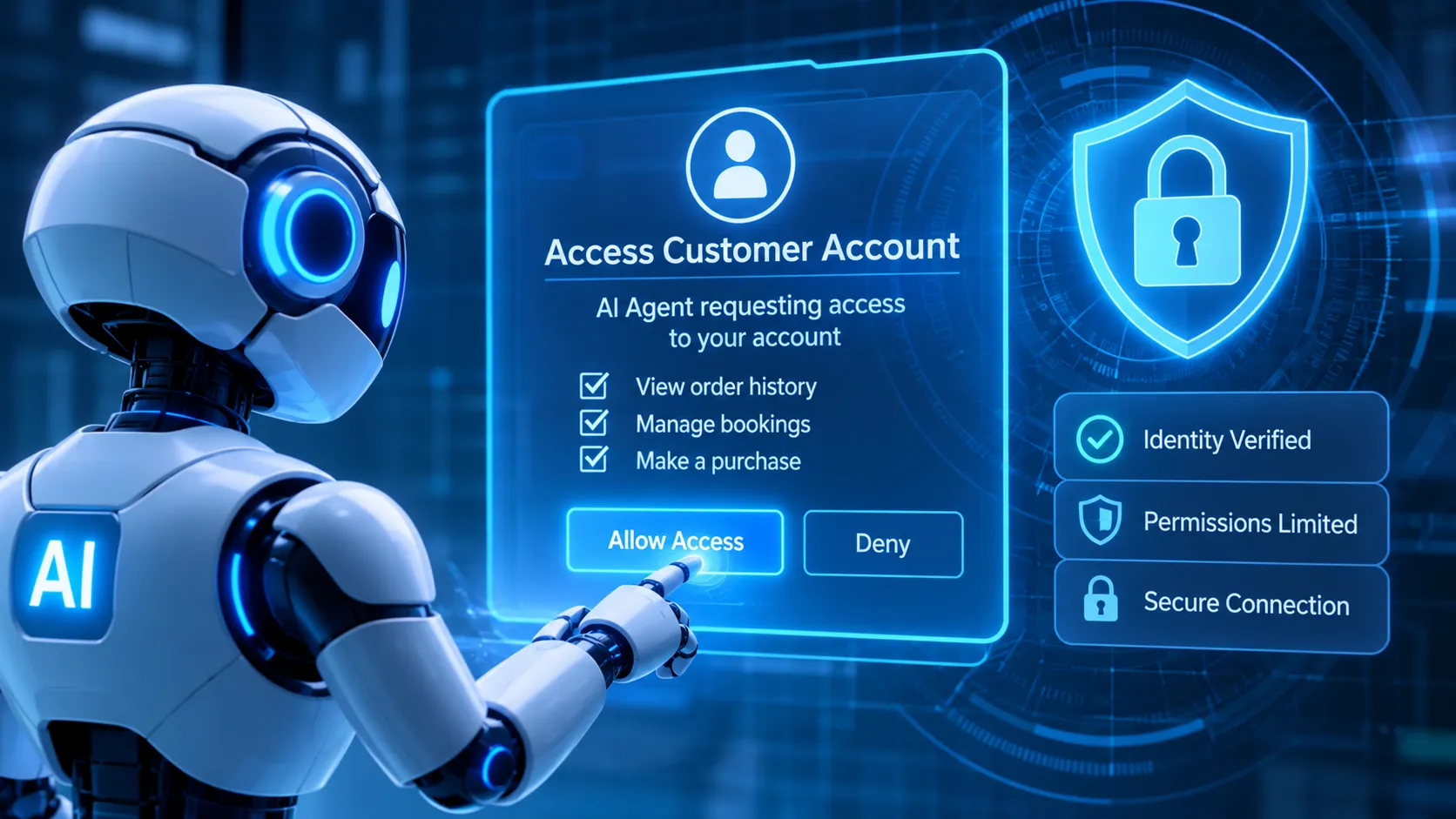
JPMorgan Chase, Charles Schwab, Amazon, Kohl's and Neiman Marcus have all been reported as restricting external personal AI agents such as Meta's Muse (CNBC, via n8nlab). On 11 November 2026, United Airlines went further, announcing that it would prohibit "unauthorised, third-party personal AI agents or assistants" on its digital platforms. For brands, that raises a bigger question: should your website welcome AI agents, or keep them out?=
The answer is rarely a flat yes or no. Start with the problem you are solving for customers, then decide what an agent may see, what it may do, and who is accountable when it acts.
The new visitors to your website aren't necessarily human
For years, businesses have invested in making websites easier for people to use: clearer navigation, simpler checkout, better search and stronger mobile experiences.
Now a new type of visitor is arriving: the AI agent. Unlike a conventional search crawler, a personal AI agent can do more than read and index. Depending on its capabilities and permissions, it can search for products, compare prices, navigate sites, complete forms, manage bookings and potentially complete transactions on a customer's behalf.
For consumers, the appeal is obvious. Instead of visiting five retailers, a customer can ask an assistant to find the best option. Instead of working through an airline website, they can ask an agent to research and arrange a journey.
For the businesses running those websites, this changes the relationship with the customer. Who is actually interacting with the brand? Who controls the transaction? Who is responsible when something goes wrong? And should an automated assistant be able to use a customer's account simply because the customer has authorised it?
Why major brands are keeping AI agents out
A growing number of established companies are drawing boundaries around third-party AI agents. What has actually been reported:
Company | What has been reported | Source |
|---|---|---|
Amazon | Deliberately blocks Meta's Muse from shopping on its site (Bloomberg report, 21 September 2026). CNBC reports it also asked Meta to remove Muse from its experience. | |
JPMorgan Chase | Restricts external agents. On its October earnings call, CFO Jeremy Barnum called shared-credential and screen-scraping methods "not secure" and warned that customers who share credentials could be responsible for unwanted agent actions. | |
Charles Schwab, Kohl's, Neiman Marcus | Reported as restricting external personal agents such as Muse. No further detail published. | |
Delta | No integration lets third-party agents book its flights. It did not confirm that it deliberately blocks specific agents. | |
United Airlines | Announced on 11 November 2026 that it will prohibit unauthorised third-party personal AI agents on its own platforms and indirectly through online travel agencies and aggregators. |
United gave three reasons: sharing account credentials with third-party agents can expose sensitive information; agents could trigger unintended purchases, account changes or MileagePlus redemptions; and automated purchases could conflict with US federal rules, such as the check-in step where a passenger must confirm that their bags contain no banned items. United says it will review the policy as personal AI assistants evolve.
Not every block is a deliberate policy. Walmart told TechCrunch that the problems Muse users reported were not intentional and were probably caused by a human-verification step that fails when interrupted. That is the real risk for brands without a policy: legacy anti-bot tools can decide the question by accident.
The underlying issue is that an AI agent may have been authorised by the customer but not by the business whose website it is using. A customer giving an agent permission to use their account does not mean the website operator has agreed to that method of access. The lesson is not necessarily to block everything. It is that agent access needs an explicit policy.
The commercial case for letting agents in
There is a strong argument for allowing agent access, particularly in retail, travel, hospitality and financial services. AI assistants are becoming another route through which customers discover products and services, and a brand that blocks every automated visitor risks being less visible to a growing group of potential customers.
Adobe's research on US retail sites shows the direction of travel:
Period | Finding | Source |
|---|---|---|
July 2025 | Traffic from generative AI sources up 4,700% year on year | |
November to December 2025 | AI-referred retail traffic up 693.4% year on year; AI visitors converted 31% more often than other sources | |
September 2026 | AI traffic grew 71% year on year; it converted 90% better and earned 83% more revenue per visit than non-AI traffic |
These figures need careful reading. They measure customers clicking through from AI tools, not autonomous agents completing purchases. The starting base was small, and Adobe notes the base of AI shopping users remains modest. The conversion picture has also changed quickly: in August 2025, Adobe's data showed AI traffic converting 9% worse than non-AI traffic. They still show why businesses should pay attention to how customers now discover and compare options.
The potential benefits:
More discovery: products and services can be recommended in response to highly specific requests.
Less friction: agents can help customers compare options and navigate complicated buying journeys.
More qualified visitors: customers arriving after AI-assisted research may already know what they want.
New distribution: brands can appear in AI-driven shopping and travel experiences without relying only on search and advertising.
Better service: with the right permissions, agents could help customers find answers, understand policies and complete routine tasks.
The commercial risk is straightforward: if customers increasingly delegate online tasks to AI, websites that refuse all agent access may gradually lose opportunities to engage with them.
The security argument: an authorised customer does not mean an authorised agent
The concerns raised by banks, retailers and airlines are legitimate. A personal agent may work using a customer's login credentials, browser session or access tokens. Once inside an account, it can reach sensitive information and take actions with financial or operational consequences. Plausible scenarios include:
An agent changes a customer's delivery address.
A shopping assistant places an order the customer did not intend.
A travel assistant changes a reservation or spends loyalty points.
An agent reads financial information beyond the scope of the request.
A malicious or compromised agent extracts personal data from an authenticated session.
There is also accountability. If an agent makes an unauthorised purchase, is the customer responsible, the AI provider, the merchant or the payment provider? These questions matter most to businesses handling payments, financial records and identity documents.
Security teams already know the wider problem. The OWASP Automated Threats to Web Applications project catalogues 21 automated threats, including credential stuffing, scraping, carding and denial of inventory. The practical lesson for agent policy is to separate legitimate activity from harmful behaviour and apply controls suited to each endpoint, rather than blocking all automation indiscriminately.
The legal and contractual dimension
Customer permission is not the whole picture, because website operators set terms for how their services may be used. The most important test case so far is Amazon v Perplexity, and it has moved since the first headlines:
Date | Event |
|---|---|
9 March 2026 | A US district court in the Northern District of California (Judge Maxine Chesney) granted Amazon a preliminary injunction against Perplexity's Comet agent, finding it likely accessed Amazon accounts without authorisation. The Register |
4 August 2026 | The Ninth Circuit vacated that injunction. It held that Amazon was unlikely to succeed on its Computer Fraud and Abuse Act and California computer-fraud claims, because on the record before it the user, not the agent, "accessed" Amazon's systems. Cooley, Jones Day |
After the ruling | The case was remanded for further proceedings. Terms-of-service, contract and tort theories were not decided, and the court limited its reasoning to the current record. |
For website owners, the practical implication is that anti-hacking law may not be enough to stop an agent acting for a logged-in customer, particularly where the agent's provider does not communicate directly with your servers. Explicit terms, technical controls and clear agent policies matter more. Terms and conditions, privacy notices, API agreements and payment-provider contracts may all need review.
The legal position varies by jurisdiction, industry and contract, and this is a fast-moving area. Brands should take legal advice before introducing restrictions or granting new permissions.
Four approaches brands can take
There is no universal answer. A retailer selling inexpensive household goods has different needs from a bank managing investment accounts or an airline handling passenger bookings. Most organisations can start with one of four approaches:
Approach | What agents can do | Best suited to | Main challenge |
|---|---|---|---|
1. Open access | Verified agents browse and perform defined customer tasks | Product discovery, comparison shopping, travel research, customer service | Reliable verification, permission management and transaction controls |
2. Limited access | Read public product information, pricing, policies and availability; customers complete purchases themselves | A sensible starting point for many businesses | Gives agents information without authority to transact, so some convenience is lost |
3. Permission-based access | Perform specific tasks the customer explicitly instructs, such as searching a catalogue, comparing prices, checking order status, retrieving bookings or preparing a basket | Businesses balancing customer convenience with control | Payments, account changes and money transfers still need extra verification or human approval |
4. Closed access | Nothing beyond public information; unauthorised third-party agents blocked from accounts and transactions | High-consequence actions, or strict regulatory and contractual requirements | Risk of ignoring the wider AI opportunity |
Blocking agents should not mean ignoring AI. Brands can still make public information available to AI discovery systems, build their own assistants or explore approved integrations. The important distinction is between allowing AI to understand a service and allowing AI to operate it.
A decision framework: six questions
Before changing access policies, answer these:
Question | What to decide |
|---|---|
1. What can an agent see? | Classify information as public, restricted or sensitive. Opening hours carry different risk from customer records and financial details. |
2. What can an agent do? | Separate browsing, searching, account access, basket creation, checkout and account changes into distinct permission levels. |
3. Can you verify the agent's identity? | Distinguish an approved agent from an unknown automated visitor. A user-agent string or the agent's own claim is not enough. |
4. Can you establish customer authorisation? | Know who the customer is, which agent is acting, what it was told to do and what limits apply. Customers must be able to withdraw permission. |
5. What happens when something goes wrong? | Have procedures for disputed transactions, accidental purchases, incorrect bookings, privacy incidents and compromised sessions, with audit records kept in line with data protection and retention rules. |
6. Does agent access fit your commercial model? | Weigh new customers, discovery and lower service costs against higher infrastructure costs, less direct engagement and effects on advertising, loyalty and attribution. |
The decision should rest on both commercial opportunity and operational risk.
How to build an agent-ready website without surrendering control
For organisations that permit some agent activity, the next step is a controlled technical framework:
Use verified agent identities. Prefer cryptographic signatures and recognised agent identity systems over easily spoofed browser identifiers. OpenAI's developer guidance, for example, says ChatGPT's cloud browser signs requests using Web Bot Auth (HTTP Message Signatures, RFC 9421). It also documents allow-list settings for Akamai, Cloudflare, HUMAN and Vercel.
Introduce permission tiers. An agent should not automatically receive the access of a human account holder (see the table below).
Protect high-risk transactions. Require extra confirmation for large purchases, transfers, payment-detail changes and cancellation of important bookings. Spending limits and transaction-specific authorisation reduce the impact of unintended activity.
Keep human approval where it matters. Customers may welcome an agent that researches, compares and prepares an action, but asks before committing money or changing important account information.
Monitor automated traffic. Measure agent activity separately from human traffic and known malicious bots. Watch for unusual request volumes, repeated account access, suspicious checkout behaviour and shifts in conversion or fraud patterns.
Avoid indiscriminate bot blocking. Legitimate agents and malicious bots can share technical characteristics, so use layered, risk-based controls.
Permission tier | Example access |
|---|---|
1 | Public information |
2 | Read-only customer account access |
3 | Limited account actions |
4 | Purchase preparation |
5 | Transactions requiring explicit approval |
6 | Restricted or prohibited actions |
Emerging standards could change the decision
The infrastructure for agentic commerce is still developing. Several initiatives aim to give agents reliable ways to identify themselves, communicate permissions and pay:
Initiative | Led by | What it does |
|---|---|---|
Agentic Commerce Protocol | OpenAI and Stripe | Open protocol for agent-led checkout |
Universal Commerce Protocol | Google, announced January 2026; Visa, Mastercard and others have joined | Standard for interoperability between agents and merchants |
Agent Payments Protocol (AP2) | Google, September 2025 | Agent payments protocol |
Trusted Agent Protocol | Visa, October 2025 | Helps merchants identify legitimate agents and pass payment credentials (Visa) |
Mastercard Agent Pay | Mastercard | Agent payments, plus an open standard co-developed with Google, announced in March, for explicit and provable user authorisation (Payments Dive) |
These point towards a future where a business can verify not only that a visitor is an agent, but whether it is authorised for a particular transaction. Brands should still not assume a protocol resolves every security, legal or customer-experience issue. Interoperability, implementation, liability and consent still matter.
So, should your website let AI agents in?
For most brands, the answer should not be a simple yes or no. Blocking every agent may avoid some risks but could shut out customers who expect AI assistants to help them research, compare and buy. Unrestricted access creates the opposite problem: l=oss of control over accounts, transactions, data and customer experience.
The most practical strategy is selective access. Let verified agents discover public information. Give approved agents clearly defined permissions. Keep sensitive customer data protected. Require stronger verification for consequential actions. Keep human approval wherever the risk justifies it. Above all, set an explicit policy rather than letting legacy anti-bot technology decide by accident.
The next generation of websites will serve two audiences: people, and the AI agents acting for them. The question is no longer simply whether agents should be allowed in. It is how much authority you are prepared to give them.
The starting point is the customer problem, not the technology. If you decide to offer AI help on your own terms, Harmony Studios builds conversational AI characters and AI video avatars designed with the client rather than tied to a third-party platform. Founded in 1995, Harmony has worked with clients including BP, Unilever, Costa, Sky, Jaguar Land Rover, the RAF, Nissan and British Airways across industrial, healthcare, training, retail, consumer, travel and entertainment. See the portfolio at www.harmony.co.uk.

About the author
Kieran Sawyer
Your idea
Talk it through with us
Tell us what you are working on, from an early idea to a brief that is ready to go, and we will think it through with you.