How many times is the same thing typed in?
Most organisations already run good systems that do not talk to each other. Together we join them, so information is entered once and moves by itself, and the copying comes off your team.
Why it happens
Good systems that do not talk to each other
An order arrives by email. Someone types it into the order system, then into stock, then into the accounts. On Friday someone else copies the week’s figures into a spreadsheet, so there is a report for Monday.
Each of those systems may be a good one. The problem is the gaps between them, and the people who fill those gaps by hand. Every copy takes time and is a chance to get a figure wrong, and the knowledge of how it all fits together often sits with one or two people. When they are away, the work waits.
So we start from what you already have. Most systems can share information, through an API where one exists or through exports and imports where it does not. With your team we join them, so the order is entered once and reaches every system that needs it. We keep each system wherever it still does the job, and replace one only when it is what holds the work back.
Sometimes the copying is a sign of something larger: a way of working that suited a smaller organisation and has not kept up. If that is the real problem, start with Business change and transformation, where we map how the work gets done today with your team before anything is built.
What we build
What changes in a working week
Most of what we build is one of four kinds of work. Together they take the copying out of the week.
Systems that pass information to each other
Your sales, stock, finance and booking systems sharing what they know, so a change made in one appears in the others. A new customer added in the sales system is in the accounts by the time the first invoice is raised, and nobody types their address twice.
Tools built round how your team works
The forms, portals and dashboards your team needs where an off-the-shelf product does not fit. One screen where a request is logged, passed to the right person and followed to the end, in place of an inbox, a spreadsheet and a reminder in someone’s diary.
Routine steps that run themselves
Reminders, confirmations and the hand-offs between teams, run by software on rules you agree with us. A delivery note arrives, the stock levels are updated and the order it belongs to is marked ready to invoice. When something does not match, a person is told, and everything else goes through.
Reports that put themselves together
The figures people ask for every Monday, gathered from your systems as the week goes on, so the report is ready when the meeting starts and every number in it comes from the same place.
Where AI fits
Automate it, assist it or leave it with people
AI is one tool among several, and not every task should be automated. Before anything is built, we go through a working week with your team and put each task on one of three lines.
Tasks from a working day
-
Automate
- Copying orders into stock
- Routine reminders
- The weekly report
-
Assist
- Drafting replies to check
- Answers from long documents
- Spotting unusual orders
-
Leave with people
- Agreeing terms
- Handling complaints
- Signing off safety work
Automate
Work that follows the same steps every time, by rules a computer can follow. Ordinary software does this the same way every time, and most of it needs no AI.
Assist
Work where the job is reading, sorting or drafting, and a person still decides. This is where AI earns its place: it does the routine part, and a person checks the result before it goes anywhere.
Leave with people
Judgement, relationships and anything where a mistake is costly stay with your team, and the systems around them give them what they need to decide.
With Quince Stoneworks, AI was not in the brief. We used it to source, check and tag over 1,000 stones from 19 brands for their new catalogue, with a person approving the result before it went live. We kept it out of the pricing, which follows the team’s own rules in ordinary code, so the same kitchen always gets the same figure.
If you are not yet sure where AI fits in your organisation, AI Consultancy is the place to start.
Which task would you take off your team first? Start a conversation
How we work
The hard part first, then the rest in stages
The riskiest part of a system is usually the join nobody has tried: an old system with no API, a supplier’s file in an awkward format, a rule that lives in one person’s head. We build that part first as a working prototype with you, so you see it working with your own data before you commit to the rest. See how we prototype.
It is the way we work on every project: understand the work with your team, prioritise what to build, prove the hard part, then build it and embed it in how your team works.
-
Agree what it must do
We write down with you who uses it, what they need from it and which systems it has to talk to.
-
Prototype the hard part
We build the riskiest piece first as a working prototype, so you can try it with your own data before committing to the rest.
-
Build it in stages
Your team uses each stage as it is finished and tells us what to change.
-
Hand over and support
We train your team, document the system and keep it up to date with you, or hand it to your own developers.
Track record
Systems still doing the job years later
What we build is meant to be changed. Some systems we first deployed nearly a decade ago still work today and are updated whenever clients ask for something new. Since 1995 we have built apps, training and systems with organisations such as Jaguar Land Rover, BP, Cummins and the RAF.
One back office behind every kiosk
With Case Station we built the kiosk where shoppers design and order a custom phone case in store, and the back office every kiosk takes its instructions from. An order went from the kiosk to print without anyone typing it in again, and a new price entered once reached every kiosk it applied to within the hour. Case Station grew to 130 kiosks across the UK, more abroad and in China, and the sale of over 280,000 custom cases, without more orders to type in or prices to update by hand. Read the Case Station case study.
A file too large to share, opened in a browser
A client’s customers needed to explore scans of the inside of wells, and a single well, written out as text, came to nearly two gigabytes. Each well used to be rendered as a video, and rendered again whenever a scan was updated. Together we built a viewer that fetches only the stretch being looked at, straight from the original file. An updated scan now means replacing one file. Read the well data viewer case study.
Every quote in one place
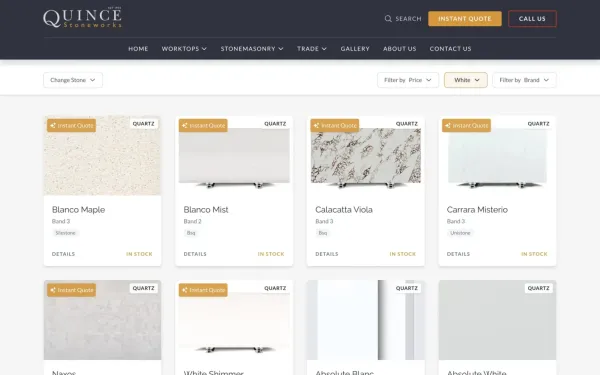
Quince Stoneworks have worked with us since 2006. When we rebuilt their site together, we gave it an instant quote that prices a kitchen by their own rules. Every quote, from the website, the showroom or the phone, arrives in one admin area, and the same PDF goes to the customer and the sales team, so nobody retypes it. Read the Quince Stoneworks case study.
Questions
Good to know
-
How much of our team’s time will it take?
Most at the start, when we go through the work with the people who do it, and at the end of each stage, when they try what has been built and tell us what to change.
-
Do we have to replace our software?
Usually not. Most systems can share information through an API, or through exports and imports. We check each one with you first, and suggest replacing a system only where it holds the work back.
-
Do we need AI for this?
Not always. Plain automation is often simpler and more predictable. We suggest AI where the work is reading, sorting or drafting, and agree with you who checks the result.
-
What happens after we send the form?
We read what you send and get in touch to talk it through. If there is something worth building, we agree with you what it must do and which part to prototype first, before you commit to the rest.
-
What if it is only one small task?
That is a good place to start. One report that puts itself together is quick to change, and it shows your team what joined-up systems look like before anything larger.
-
 Retail
Case Station
With Case Station we built the kiosk where shoppers design and order a custom printed phone case in store. It led to the sale of o...
Read the story
-
 Training & Education
Unity WebGL HDF5 Data Visualisation Tool
With a client’s data scientists we built a viewer that lets people travel the inside of a well in a web browser. It reads only the...
Read the story
-
 Consumer
Quince Stoneworks
With Quince Stoneworks we rebuilt their website around an instant quote form that follows their own pricing rules, and used AI to...
Read the story
Start here
Tell us what gets typed in twice
Tell us which task your team repeats most, or which systems will not talk to each other. A few lines is enough. We will read it, then work out with you what is worth building.
Rather talk now?
[email protected] +44 (0)1767 317614 Book a meeting (opens in a new tab)
How we help
The other ways we work with you
-
AI Consultancy
An AI Opportunity and Risk Review: find the uses that pay back, join them to your systems and manage the risks.
-
Business change and transformation
Find where time and money are lost in the way work gets done, and change it with the people who do the work.
-
Training and adoption
Training and support built round each role, so a new system or way of working is the one people use.