The system is live. Are people using it?
We build training and support round each role with you, so the new system or way of working becomes the one people use every day.
Why it happens
A launch is a date. Using it is a habit.
The new system goes live on a Monday. By the end of the month the awkward orders are back in the old spreadsheet, and someone copies them across by hand every Friday.
People go back to the old way because it still works and they know it. Nobody has shown them what the new one does for their own job: sales and the warehouse sat through the same demonstration, weeks before either needed it.
One training session and a manual do not change that. Until something does, the system holds some of your records, the spreadsheet holds the rest, and the reason you paid for the change does not arrive.
Left alone, use of a new system tends to rise in the first week, because everyone has been told to use it, then sag as the difficult cases drift back to the old way. Where people have practised beforehand, have a named person to ask and know the date the old way is switched off, it keeps climbing.
Sometimes the trouble is not the training. If people avoid the system because it makes their job slower, or because its process never matched how the work gets done, more training will not help. That is a question for business change, or for systems and automation if the system itself needs to change, and we will say so when we find it with you.
Before the launch
Six questions to ask before the launch
If you are about to launch, or launched recently and fewer people use the system than should, start here. Any question you cannot answer yes to is where the old way is most likely to win.
- Does each role know what changes for them on the first day? People need their own part of the job, not a tour of every screen. Without it they wait to be shown and carry on as before.
- Has everyone practised on something that looks like their own work? Watching a demonstration is not doing it. Practice on their own orders or jobs, where a mistake costs nothing, makes the first real day feel familiar.
- Is there one person in each team the others can ask? Questions come in the first weeks, in the middle of a job. A named colleague answers them in a minute; without one, people ask whoever sits nearest, who may still use the old way too.
- Can someone find the answer without leaving the system? Help inside the system gets used. A manual in a shared folder does not, because finding the page takes longer than doing it the old way.
- Is there a date for switching the old way off? While the spreadsheet still works, it will be used for the difficult cases. A date agreed with each team, and kept, tells everyone the new way is the only way.
- Do you know how you will tell whether people are using it? The system’s own records show who uses which part and where people give up. Agree what good use looks like before the launch, so you can check instead of guessing.
Cannot answer yes to all six? Tell us which, and we will work on them with you. Start a conversation
What we make
Training people come back to
We have made training for thirty years, from short films and guides to full simulations in virtual and augmented reality. We choose the medium with you for each task, and most training needs nothing more than the screens your people already use.
-
Training by role
Only the part that changes for them
Short sessions for each role on what is different in their job from the first day, built with people from that team round their own customers, orders and jobs. The warehouse and the finance team use different parts of the system, so they get different training.
-
Help at the point of work
Answers where people get stuck
Short films, step-by-step guides and help inside the system itself, written with the people who will use them. Each answers one question, so it can be found in the moment someone is stuck.
-
A safe place to practise
Mistakes made before they matter
A practice copy of the system with realistic records, or a simulation of the task, so the first real day feels familiar. Where the real work is costly, rare or unsafe to rehearse, we build the practice with you in virtual or augmented reality.
Explore AI-Driven Training Simulations -
Support after the launch
Checked in the system’s own data
We agree with you before the launch what good use looks like, such as every order going through the new system, then check it together afterwards. Where a team is still working round it, we find out why with them and change what is not working.
Track record
Training we have built before
Since 1995 we have built apps, training and systems with organisations such as Jaguar Land Rover, BP, Cummins and the RAF. Much of that training had one aim: people confident in a job before they do it for real.
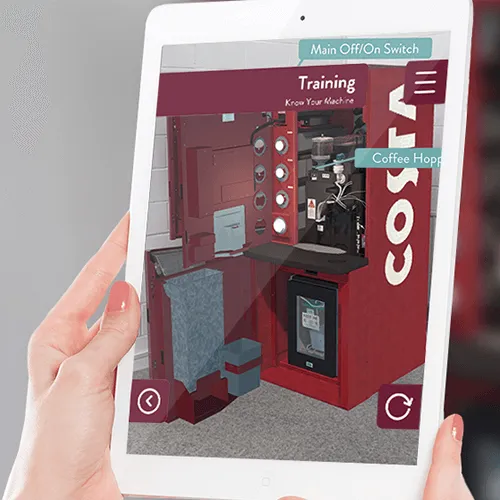
Costa Express machines stand in more than 8,000 shops and forecourts across the UK, run by partners’ staff on every shift, so sending a trainer to each one is not practical. Together with Costa we built the Costa Express Support app, which staff use on their own phones and tablets: augmented reality puts the machine in front of them at full size for basic training, maintenance and fault-finding at their own pace, and progress is recorded by person, by site and by machine. Read the Costa case study.
At the NCC, beginners cannot practise siting a caravan for real, because it is unsafe without a qualification. Together we filmed a real siting from start to finish in 360 and turned it into eight short chapters in virtual reality. The trainer moves every headset in the room on to the next chapter together. Read the NCC case study.
When training had to happen at a distance in 2020, we worked with organisations to move hands-on learning online, with decision trees that adapted it to each learner and analysis that showed where teams struggled. In 2021 we won Innovate UK funding to build a virtual training room, where trainees learn together and the trainer runs the session from a desktop.
How we work
From the first session to steady use
Training follows the same four stages as the rest of our work with you: understand, prioritise, prove, then build and embed. Here it starts with a list of who is affected, not a training plan.
-
Find who is affected
Together we list every role the change touches and what is different for each, with the people who do the work.
-
Build it with them
We write and film the training with people from each team, on their own examples, and try it with a few of them first.
-
Support the launch
Practice before go-live, help inside the system and a named person in each team for the first weeks.
-
Check and adjust
We look at how the system is used with you after launch and change what is not working.
Questions
Good to know
-
How much of our team’s time will it take?
Some, because the training is built on their work: short sessions with a few people from each team while we build it, then time for everyone to practise. We plan it with you round the busy parts of your year.
-
Do we need new software or headsets?
No. Most training is short sessions, films, guides and help inside the system you already have. Virtual or augmented reality is only worth it where the real work is costly, rare or unsafe to practise, and we decide that with you.
-
What happens first?
A conversation about what you have launched, or are about to, and who has to use it. Then we look at the system with your team and agree with you where training will make the most difference.
-
What if it is one team and one small change?
That is a good place to start. Training for one team on one change is a small piece of work, and it shows you what helps before the next launch.
-
Can you train people on a system you did not build?
Yes. We learn the system with your team first, then build the training round the jobs people do in it.

Start here
Tell us who needs to use it
Tell us what you have launched, or are about to, and who needs to use it. A few lines is enough: we will read it, then work out with you what would help them most.
Rather talk now?
[email protected] +44 (0)1767 317614 Book a meeting (opens in a new tab)
How we help
The other ways we work with you
-
AI Consultancy
An AI Opportunity and Risk Review: find the uses that pay back, join them to your systems and manage the risks.
-
Business change and transformation
Find where time and money are lost in the way work gets done, and change it with the people who do the work.
-
Systems and automation
Software that joins the systems you already run and takes the repeated steps out of the working day.